
See the work. Review it. Give feedback. Approve it.AIWA’s client sharing and review workflow helps agencies involve clients in the project without giving them unnecessary control over the building process. Build with AIWA. Share with your client. Collect feedback. Make changes. Get approval.
Client sharing and review features are available on the AIWA Agency plan.
A Better Client Review Workflow
Traditional client development can quickly become messy. You build something. Then send screenshots. The client replies by email. Then sends another message on WhatsApp. Someone else adds feedback in Slack. Another stakeholder sends a document. Soon, feedback is spread across several different places. A better workflow is:Share the Actual Experience
Screenshots are useful, but they don’t always show how an application actually feels. A client may need to:- Navigate between pages
- Open menus
- Complete forms
- Test interactions
- Review mobile layouts
- Follow important workflows
- See how different screens connect
Share Your Project for Review
When your project reaches a stage where you’d like client feedback, use AIWA’s sharing and review functionality to give the client access to the appropriate project experience.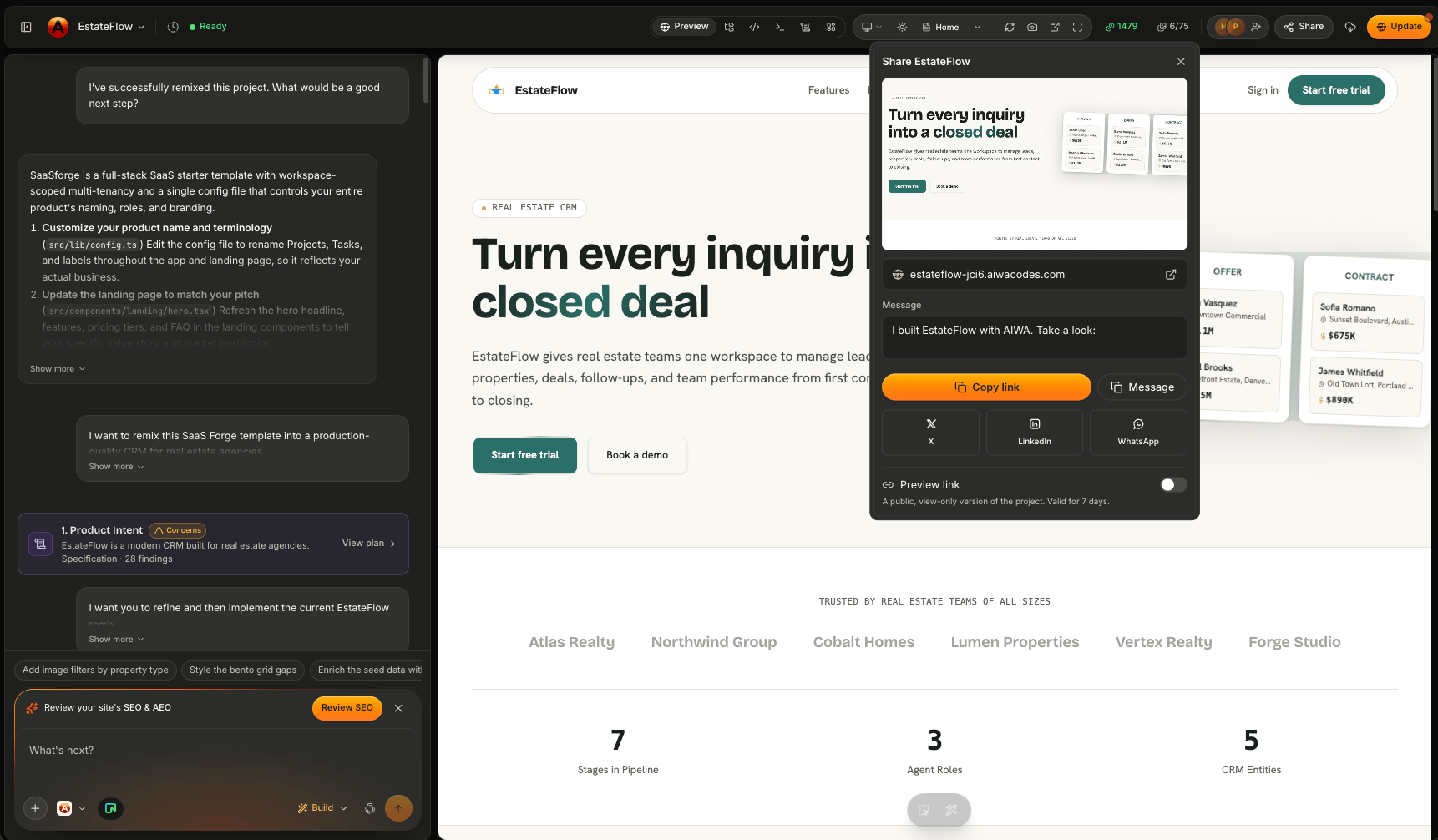
Review Before Publishing
You don’t have to publish every change before a client can evaluate your work. A useful agency workflow is:What Should Clients Review?
Don’t simply send the project and say:Let me know what you think.Give the client some direction. For example:
We’ve completed the new booking experience. Please review the homepage, service selection, booking flow, confirmation screen, and mobile experience.This focuses their attention on the work you’ve actually completed.
Review by Milestone
For larger projects, don’t wait until the entire application is finished before asking for feedback. Break the project into milestones. For example:Example: Website Project
Suppose your agency is building a website for a law firm. The first version contains:- Homepage
- About
- Practice areas
- Attorneys
- Contact
- Consultation form
Please review the homepage messaging, attorney profiles, practice-area content, and consultation flow.The client can focus on business accuracy while you handle implementation.
Example: SaaS Application
For a more complex application, review can happen in stages. Suppose you’re building:- Authentication
- Dashboard
- Customers
- Projects
- Payments
- Reports
- Settings
Example: Booking Application
Imagine you’re building an application for a fitness studio. Ask the client to test the actual customer journey:Client Feedback
Once the client reviews the project, they can identify changes they’d like made. Feedback might include:- Change the homepage headline.
- Make the booking button more prominent.
- Add another service category.
- Move testimonials above pricing.
- Customers should be able to reschedule appointments.
Turn Feedback Into Clear AIWA Requests
Client feedback isn’t always written like a development specification. A client might say:The dashboard feels too busy.Before immediately asking AIWA to redesign everything, translate that into something more specific. For example:
Simplify the dashboard hierarchy. Keep all existing functionality, but make the four primary metrics more prominent, reduce unnecessary visual density, and move secondary information lower on the page.AIWA can then work from a clearer instruction.
Don’t Automatically Implement Every Request
Sometimes a client request can affect other parts of the application. For example:Remove the customer account requirement.That could affect:
- Authentication
- Bookings
- Payments
- Customer history
- Saved information
- Permissions
The client wants customers to book without creating an account. Analyze how this would affect the existing booking, payment, customer history, and authentication workflows. Create a plan only. Don’t make changes yet.Then review the implications before building.
Feedback → Build → Review
Client development is usually iterative.Review Changes Before Sending Them Back
When AIWA completes a requested change, review it yourself before sending the project back to your client. Check:- Did AIWA implement the request correctly?
- Did anything else change unexpectedly?
- Does the feature work?
- Does it work on mobile?
- Did existing functionality remain intact?
Separate Feedback From Approval
Feedback and approval are different stages. A client saying:This looks much better.doesn’t necessarily mean:
This version is approved for production.For important projects, make the approval point explicit. Your workflow could be:
Multiple Client Stakeholders
Sometimes you’re not working with one client contact. You might have:- Business Owner
- Marketing Manager
- Operations Manager
- Technical Lead
Protect the Building Environment
Clients generally don’t need the same access as the people actively building the application. Your development team may need to:- Prompt AIWA
- Modify functionality
- Debug
- Change application structure
- Work with integrations
Client Review for Live Applications
Client review remains useful even after an application has launched. Suppose the client requests:Add a customer loyalty program.The application is already being used by customers. Instead of building and immediately publishing:
Keep Production Stable
When working on an existing client application, remember that the live version may contain:- Real customers
- Real payments
- Real bookings
- Business data
- Active integrations
Client Review for Mobile Apps
If you’re preparing an Android or iOS application for a client, involve them before final export. For example:Client Ownership
For agency projects, establish ownership early. Clarify things such as:- Who owns the project?
- Who owns the domain?
- Who manages integrations?
- Who owns external service accounts?
- Who owns mobile developer accounts?
- Who manages the application after delivery?
A Strong Agency Workflow
A good end-to-end AIWA agency process might look like:AIWA as Your Agency Product Team
For an agency, AIWA can sit between the client’s requirements and the finished product.Next: Commenting on a Preview
The final page in Teams & Collaboration is Commenting on a Preview. That’s where we’ll get more specific about the feedback mechanism itself:- Reviewing the preview
- Leaving comments
- Commenting on specific areas
- Writing useful feedback
- Reviewing client comments
- Turning comments into changes
- Resolving feedback
- Running another review round
Commenting on a Preview
Leave and manage comments on an AIWA preview to gather focused feedback.